Driveway design used to be a choice between two shades of grey and a pattern nobody looked at twice. That has changed remarkably fast. Across Markham, Richmond Hill and the wider GTA, the interlock driveway designs coming out of yards this season are quieter, larger in format and considerably more architectural than anything being installed a decade ago.
Here is what is genuinely exciting at the moment, and why each of these looks tends to hold up rather than date badly.
Large Format Slabs and the Quiet Look
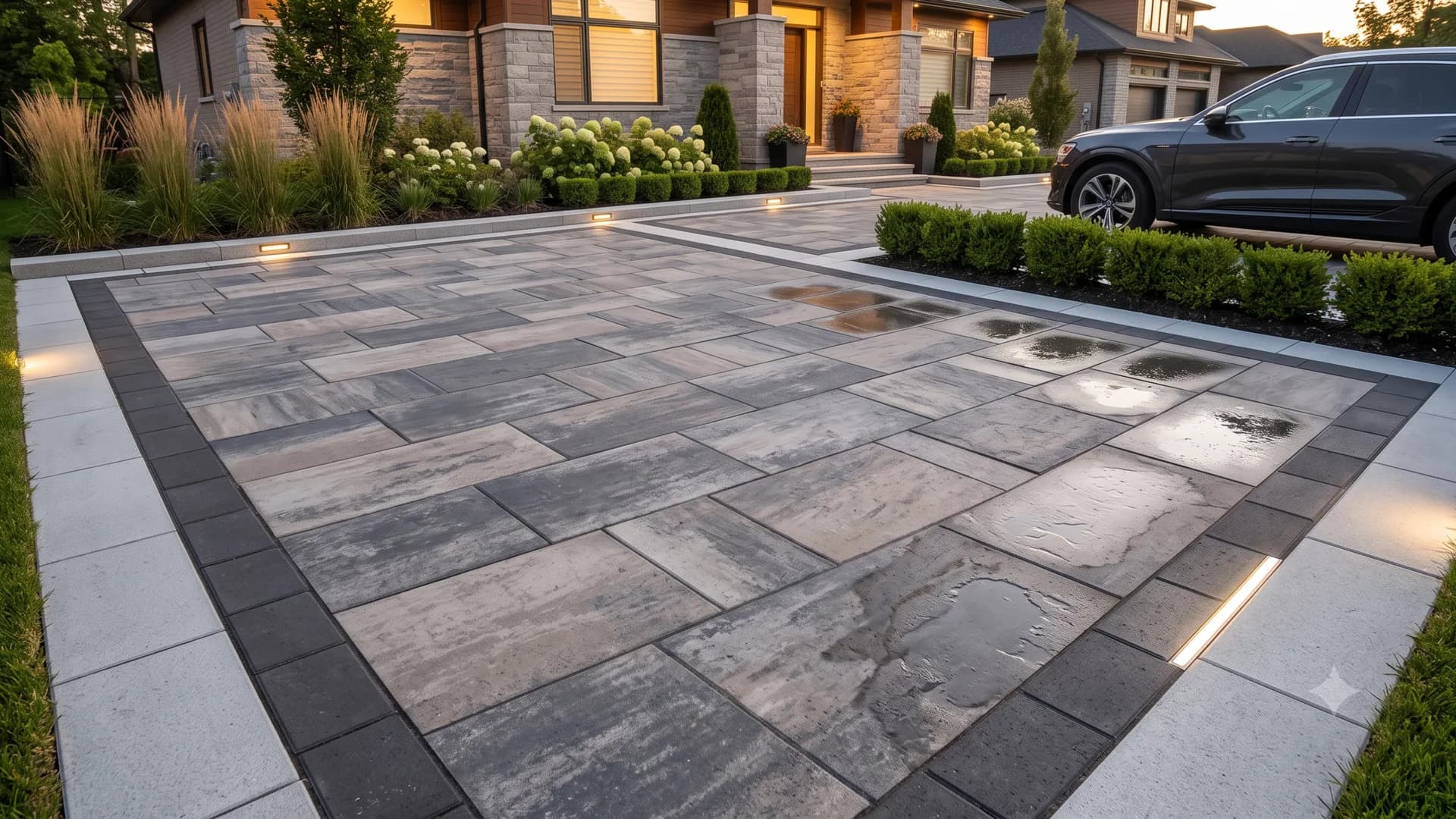
The clearest shift is scale. Big rectangular slabs, some running well over a foot in each direction, have moved from commercial plazas onto residential driveways, and the effect is striking. Fewer joints mean fewer lines, and fewer lines mean the eye reads the driveway as a single continuous surface rather than a mosaic.
The look is calm, wide and expensive without ever being loud. It suits contemporary architecture especially well and it flatters a large frontage. It also demands a base built properly, because large units are far less forgiving of settlement than small ones. When it is done right, as in several recent builds in our project archive, the driveway simply recedes and lets the house do the talking.
Scale does have limits worth respecting. On a short or narrow frontage, very large units can read as though the driveway was borrowed from a bigger house, and the number of cut pieces along the edges climbs quickly, which always shows. A mid format slab often delivers the same clean effect on a compact lot without the awkwardness.
Borders That Do More Than Frame
Borders are having a moment, and the interlock driveway designs drawing the most attention no longer settle for a single row of contrasting stone around the perimeter. Double borders, one dark and one light, are showing up on wide driveways to give them structure. Soldier courses running perpendicular to the field add a crisp finish along the edges where the driveway meets grass or garden.
The most interesting version divides the driveway itself, using a band of contrasting stone to separate the parking area from the walking route to the front door. It is a small design move with a large effect, because it tells visitors where to walk without a single sign. Decisions like that belong at the drawing stage, which is why they usually emerge during landscape design rather than on installation day.
Colour Moving Toward Stone and Shadow
Warm orange and red toned pavers, so common on driveways built in the early two thousands, have largely given way to a cooler and more natural palette. Charcoals, slate greys, soft taupes and blended tones that mimic quarried stone are what homeowners are asking for now.
There is a practical reason behind the fashion. Blended and mid toned stone hides winter grime, tire marks and the general reality of a Canadian driveway far better than either extreme does. A blend also disguises the small variations between production batches, which pure single colour fields tend to reveal under strong afternoon light.
The other quiet change is texture. Tumbled and shot blast finishes, which soften the face of the stone and take the factory sheen off it, are being specified far more often than the smooth surfaces that dominated a decade ago. Underfoot the difference is minor. Visually it is substantial, because a textured face catches light unevenly and reads as quarried rather than manufactured, which is precisely the effect most homeowners are after when they ask for something natural.
Interlock Driveway Designs Built for Evening Light
The last trend is the one people notice most and plan for least. Lighting has become part of the driveway rather than an afterthought bolted on beside it. Low recessed fixtures set into the border, or slim wall washers running along a retaining edge, turn the whole surface into something worth looking at after dark.
Paired with a permeable band along one edge, or a strip of turf set between stone at the apron, it gives a driveway texture and depth that photographs beautifully and, more importantly, feels considered every time you pull in. These are the interlocking driveway details that separate a finished project from a paved surface.
Trends are only useful when they suit the house they are attached to, which is why the same design rarely translates from one street to the next. We build throughout the service areas we cover across the GTA and York Region, and every one of these looks has been adapted to a very different property.