An interlock driveway is one of the few improvements that changes how a house is read from the street. Asphalt disappears. Stone announces. It is also, quietly, one of the most technical jobs that ever happens on a residential property, and almost everything that determines whether it still looks flawless in fifteen years is buried where nobody will ever see it.
Most homeowners book on the strength of a photograph and a price. It is worth understanding what sits underneath both of them.
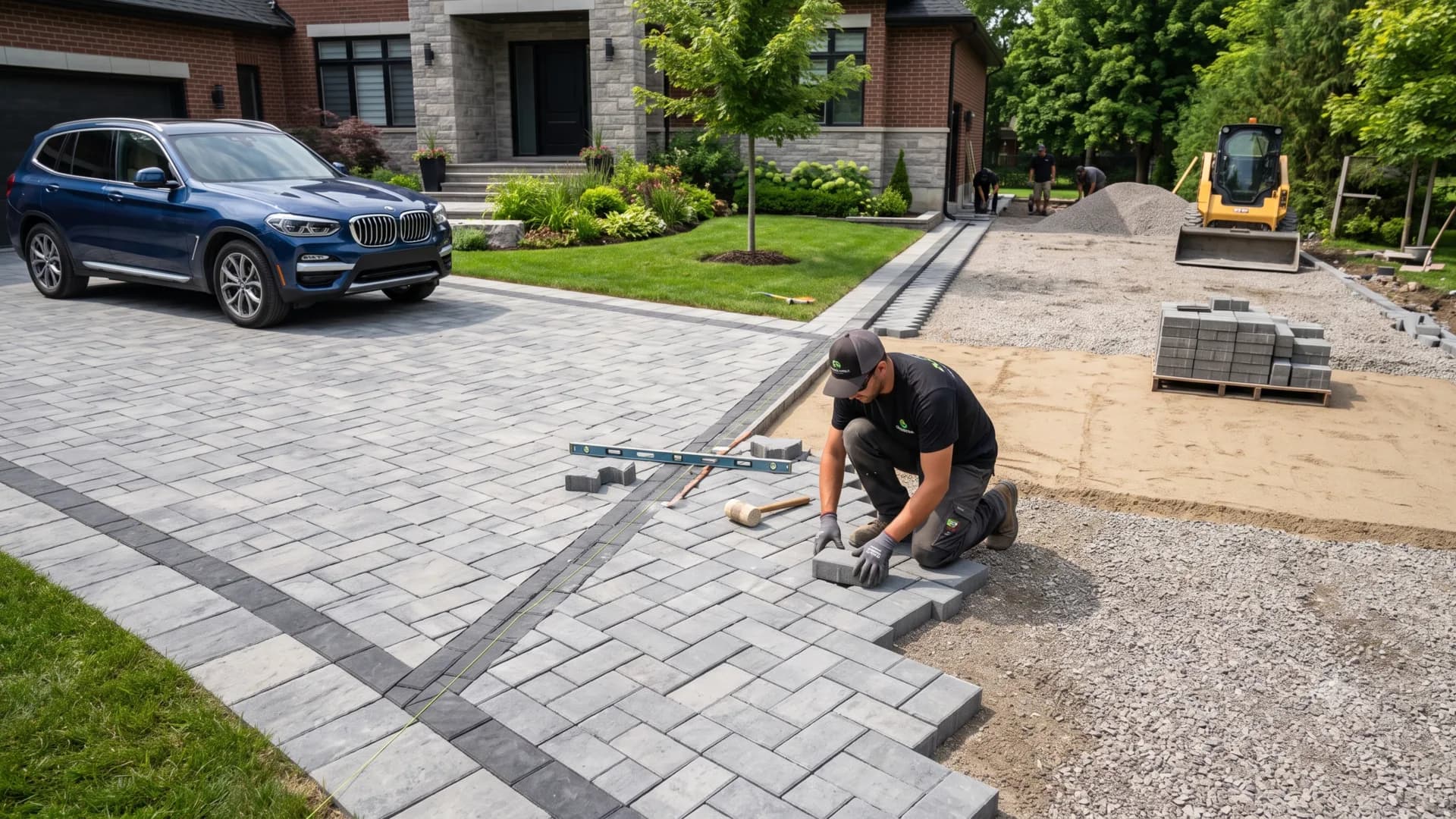
What Actually Sits Under an Interlock Driveway
The stone on top is the finish, not the structure. Beneath it sits a layer of bedding sand, and beneath that a compacted granular base that carries every vehicle which will ever park on it. In our climate that base does something even more important. It manages the freeze and thaw cycle that destroys badly built driveways, allowing water to drain away rather than sitting underneath the surface and heaving it upward every March.
Base depth is the single number worth asking about. A patio can sit happily on a shallow base. A driveway carrying two vehicles, and occasionally a delivery truck, cannot. Excavation to proper depth, compaction in layers rather than all at once, and correct grading away from the house are the difference between a driveway and an expensive rebuild. That preparation work is closer to excavation and grading than to decoration, and it deserves to be quoted just as seriously.
Choosing Stone, Pattern, and Colour
Once the base is settled, the visible decisions begin. Concrete pavers dominate residential work because they are consistent, strong and available in an enormous range of formats. Larger slabs read modern and calm. Smaller units read traditional and cope far better with curves and irregular shapes.
Pattern affects strength as well as appearance. Herringbone laid at forty five degrees to the direction of traffic interlocks most effectively under vehicle loads, which is precisely why it has been the standard for driveways for decades. Running bond and stack bond look cleaner but are better suited to walkways and patios where loads are light.
Colour is where regret usually lives. Very pale stone shows tire marks and winter grime. Very dark stone shows dust and efflorescence. Mid tones in grey, charcoal and warm beige age most gracefully, and a contrasting border gives the driveway a defined edge that keeps it looking deliberate for years. You can see how those choices resolve in practice across our finished driveways.
What the Installation Week Looks Like
A typical residential interlocking driveway runs somewhere between three days and two weeks, depending on size, site access and how much excavation is required. Day one is demolition and removal of the existing surface. Then comes excavation, base installation and compaction, which is by far the slowest and least photogenic part of the whole job.
Screeding sand, laying stone, cutting edges, installing edge restraint and compacting the finished surface follow. Finally polymeric sand is swept into the joints and set with water, which locks the field together and resists weeds and insects. Expect noise, a skid steer, and a driveway you cannot use for the duration. Expect the crew on site daily.
Access shapes the schedule more than most homeowners expect. A driveway a machine can reach directly moves quickly. A narrow side yard, a slope, mature trees close to the work, or a neighbouring property that limits where material can be stockpiled all add days to the job. It is worth asking during the quote how machinery will reach the site, and where excavated material and new base will sit while the work is underway, because that answer usually explains the difference between two otherwise similar prices.
Budget, Timing, and Booking an Interlock Driveway With Confidence
Price varies with square footage, stone selection, site access, elevation changes and how much material has to be hauled away. Quotes that come in dramatically cheaper than the rest usually save money in one of two places, base depth or edge restraint, and both of those failures surface within a few winters.
Ask as well what is not included. Removal and disposal of the old asphalt, adjustment to a garage apron, relocating a downspout, or restoring the strip of lawn along the new edge are all routine parts of the job that occasionally arrive later as extras.
Timing matters just as much. The season runs from spring thaw through to late autumn, and good crews book out months in advance. If you want an interlock driveway finished before winter, that conversation should be happening well before summer ends. Request a quote with your measurements and a few photographs, and you will get a far more accurate number than any online calculator can produce.